
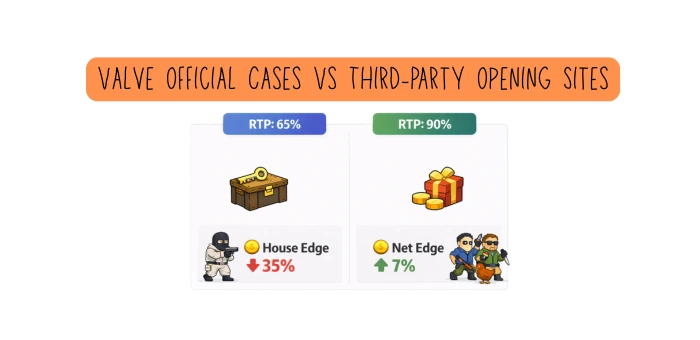
Whether you're opening CS:GO or CS2 cases on Steam or a third-party website, there is always an inherent cost beyond the initial price tag.
A percentage of every dollar spent is lost to the system. This isn't a controversial secret or a hidden trick. It's simply the reality of how case openings work, regardless of where you open them.
Now let's say you know all of that and still decide to open the next case.
Maybe you're trying to strike it rich, in which case the math in this article will show you it's bordering on the impossible. Or maybe you're just opening cases because you enjoy it, which is fine too if you understand the money burning part.
But regardless of your reason, the next logical question you should ask yourself is: how much am I actually losing per case?
The gap between the best and worst options across the skin gambling ecosystem is so wide that picking the wrong platform, or even the wrong case on the right platform, can mean paying two, three, or five times more in expected losses.
To avoid being on the wrong side of that math, you need to understand three terms: RTP, House Edge, and Net Edge.
RTP, House Edge, and Net Edge
These three terms (or rather, the numbers behind them) tell you everything about what a case or any game mode actually costs you, regardless of the platform.
They're related, but each one tells you something the others don't.
Infographic explaining how CS2 sites bonuses lower the effective house edge. A CT character pays $60 to a T character representing the site, which splits into $55 RTP and $5 house edge, then the T gives $2 bonus back
RTP (Return to Player)
RTP represents the percentage of your money you get back on average per dollar spent.
A case with 90% RTP returns 90 cents per dollar over time. The remaining 10 cents is lost to the system. This applies everywhere. Whether you're opening a Valve case on Steam or a custom case on a third-party site, you can always calculate the RTP by comparing the expected value of what's inside to the price you paid to open it.
Every item in a case has a drop probability and a market value. Multiply each item's chance by its value, add them all together, and you get the expected value (EV) of the case. Compare that to the case price and you've got your RTP.
House Edge
House edge is the flip side of RTP. If a case has 90% RTP, the house edge is 10%. Same math, just looked at from the platform's side instead of yours.
In practice, this term applies to third-party case opening and gambling sites, where you deposit funds and the site profits from the mathematical spread between your wager and the expected value of the outcome. Valve's model is different since they make their money from key sales and the ~15% Steam Market fee, not from an odds-based margin. But the end result is the same: you get back less than you put in.
Net Edge
Net edge is a term used for third-party case opening sites. It's the house edge after subtracting whatever the platform returns to you through rewards: rakeback, free daily cases, level bonuses, rain drops, promo codes.
A site with a 5% house edge that gives 3% back through its reward system has a 2% net edge. That's the actual effective cost of playing on that platform per wager, and it's the only number that tells you what you're really paying after everything is factored in.
This is where a lot of surface-level assumptions fall apart. A 25% rakeback on a 10% house edge still nets out to 7.5%. A 10% rakeback on a 4% house edge nets out to 3.6%. The second site has "worse" rewards on paper but costs you half as much per wager.
So if you're comparing platforms and only looking at the rakeback percentage or the bonus size without checking what the base house edge actually is, you're missing the point.
There's also a practical layer that goes beyond math. Some reward structures are designed to look better than they perform. Streak bonuses that reset to zero if you miss a single day. Weekly payouts that penalize you for claiming early. The gap between what a site advertises as its reward return and what players realistically collect can be significant, and that gap quietly inflates your real net edge above what you'd calculate on paper.
Factors Influencing CS2 Case RTP
Valve's official drop rates behind every standard weapon case in Counter-Strike break down like this:
| Rarity | Drop Rate | Odds |
|---|---|---|
| Mil-Spec (Blue) | 79.92% | ~4 out of 5 |
| Restricted (Purple) | 15.98% | ~1 in 6 |
| Classified (Pink) | 3.20% | ~1 in 31 |
| Covert (Red) | 0.64% | ~1 in 156 |
| Knife / Gloves (Gold) | 0.26% | ~1 in 385 |
The base odds are straightforward, but when you start looking at individual cases and the skins inside them, the math gets more layered. Every skin has extra variables that directly affect its market value: whether it drops with StatTrak, the exact float value, and the specific pattern.
StatTrak
StatTrak only has a 10% chance of rolling on any drop. So if the odds of pulling a knife are 1 in 385, adding that 10% StatTrak roll means a StatTrak knife works out to roughly 1 in 3,850.
Float Value (Condition)
On top of the rarity roll, the float value determines the skin's wear condition. The approximate distribution looks like this:
- Factory New: ~3%
- Minimal Wear: ~24%
- Field-Tested: ~33%
- Well-Worn: ~24%
- Battle-Scarred: ~16%
To put that in context, unboxing a Factory New Covert skin is about 0.64% × 3% \= 0.019%, or roughly 1 in 5,200 openings.
Pattern Index
Then there's the Pattern Index, a random seed from 1 to 1,000.
Think of it like a huge wallpaper design. Every time a skin drops, the game randomly picks a different spot on that wallpaper to cut your weapon's texture from. Same wallpaper, different cutout every time.
Static Skins: Something like the AWP Asiimov looks identical every time. The pattern seed doesn't change the artwork at all.
Randomized Skins: For skins like Case Hardened, Fade, Crimson Web, or Doppler, the seed shifts the texture around. Hitting a rare seed can give you something like a "Blue Gem" that completely changes the market value. Older filler skins like Safari Mesh technically have patterns too, but the visual differences are so minor that nobody pays a premium for them.
Valve Case RTP in Practice
When you take all those drop rates and compare them to real skin market prices over time, Valve cases generally sit at an RTP of around 40% to 78%. For every $100 you spend opening cases, you can expect to get roughly $40 to $78 back in skin value.
Where a case lands in that range depends on what's inside it. Cases with highly sought-after Coverts and popular knives tend to sit on the higher end.
Older cases get hit the hardest because the case itself has become rare, which inflates the price you pay just to open it. But the drop rates inside are exactly the same.
For comparison, regulated casino slot machines are legally required to return at least 75% to 85% to players, and most modern slots sit around 92% to 97%. In a lot of cases, Valve's case openings are mathematically worse than a slot machine. The difference is they're wrapped in a video game, so they don't feel like traditional gambling, even though the underlying mechanics work the same way.
How Third-Party Sites Compare
Third-party case-opening and gambling sites run on a different model than Valve but the player-facing math is the same: drop rates multiplied by item values equals expected value, and the gap between that EV and the case price is the platform's margin.
This is where house edge and net edge apply in the traditional sense.
| RTP | House Edge | Net Edge (after rewards) | |
|---|---|---|---|
| Valve (Steam) | 40 - 60% (up to ~78% for best cases) | N/A (retail model) | N/A (no rewards) |
| Third-party (best cases) | 93 - 97% | 4 - 7% | ~3 - 5% |
| Third-party (average) | 89 - 91% | 9 - 11% | ~6 - 9% |
| Third-party (worst cases) | 71 - 88% | 12 - 29%+ | ~similar (weak rewards) |
The RTP gap between Valve and the better third-party options is large on paper. But it's important to understand what that gap doesn't mean.
It doesn't mean third-party sites are a good deal. It means they're a less bad deal. Both systems are negative-EV by design, and both are built around the same psychology to keep you spending.
What makes this interesting is how sensitive the math is to small changes in drop probability. Imagine a $10 case on a third-party site that drops either a $5 common skin or a $50 rare skin. If you have a 10% chance to hit that rare skin, the house edge is a tiny 5%. But if the site adjusts your chance down to just 5%, the house's cut jumps to almost 30%. A 5% shift in drop rates completely changes the real value of the case.
If you want to see this play out before spending real money, you can test both Valve and third-party case odds using the [case opening simulator]. Run 1,000+ openings with real drop rates and watch what happens to your balance over time. Reading percentages on a page is one thing. Watching your simulated bankroll drain across hundreds of runs, even on high-RTP cases, makes the math real in a way that numbers alone never will.